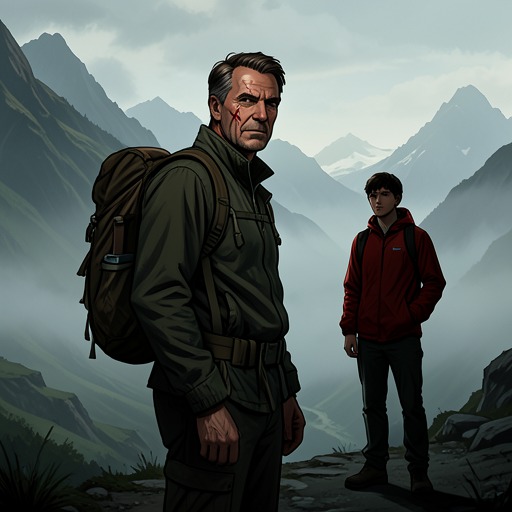
The Friendship Between Giovanni Guasti and Piero
The Eight Mountains: A NovelThe Friendship Between Giovanni Guasti and Piero began in childhood and grew through years of shared mountain journeys, making it both a central companionship in Giovanni’s early life and the relationship whose loss reshaped his future. Piero was Giovanni’s closest friend and the brother of the woman who would become Giovanni’s wife. Their friendship joined a common love of the mountains to contrasting temperaments; its abrupt end in an avalanche left Giovanni grieving and blamed, while Piero’s family withdrew from him.
Childhood and the Making of a Friendship
In the 1950s, Giovanni and Piero were inseparable friends, both born in 1942 and five years younger than Piero’s sister. They met as children at a campsite where the village priest took them. Each summer they spent a month in the Dolomites, sleeping in a tent, playing in the woods, learning mountain skills, and looking after themselves. Their friendship took shape through this repeated outdoor life: the mountains were not an occasional backdrop but the setting in which they learned how to be together.
Giovanni also became a familiar presence in Piero’s family home. He was an orphan and attended boarding school, but his circumstances did not set him apart in a community where taking in another family’s child was familiar. His energy, imaginative spirit, and infectious high spirits made him welcome. Piero’s sister remembered him as restless, as if he needed to run in order to expend his energy. The friendship thus extended beyond the two young men: Giovanni had long been part of the household and was known to Piero’s family before he became Piero’s sister’s partner.
Different Temperaments, Shared Expeditions
Their differences helped make them effective companions. Piero excelled at school and was reflective and taciturn, with a sensitivity that made him attentive to other people but also vulnerable to stronger personalities. He wanted to study medicine and seemed suited to it through his capacity for compassion and listening. Giovanni, by contrast, was more absorbed by the material world than by people. At nineteen he began studying chemistry, drawn to earth, fire, air, and water and to the substances of the natural world.
In the mountains, Giovanni was usually the planner. From June to September, almost every Saturday, the two would travel by bus toward Trento or Belluno and hitchhike back up into the mountains. They spent nights in meadows or haylofts and had little money. The Alps offered them a setting for adventure without requiring the means available to wealthier climbers. Giovanni studied maps and devised routes; Piero was more cautious, but once committed he was stubborn and hard to turn back. That persistence balanced Giovanni’s tendency to abandon a plan when it went awry. Their partnership depended not on identical approaches but on complementary ones: one imagining the route, the other sustaining the effort.
Winter Climbing and Piero’s Death
After Giovanni graduated in chemistry, he completed military service in the Alpine artillery, moving with his company across valleys and along mule tracks associated with the Great War. The experience introduced him to long marches and snowbound encampments. He returned from service changed by the harder life he had encountered and began speaking to Piero about snow: its changing forms and the different world of the mountains in winter. His enthusiasm persuaded Piero to join him in exploring terrain they had previously known in warmer seasons.
At Christmas in 1968, soon after Giovanni’s discharge, they began their first winter season together. They borrowed skis and sealskins, revisited familiar places, and stayed in refuges rather than sleeping outside. Neither had the money to hire an Alpine guide, and their technique remained limited. Giovanni believed that strong legs could get them up and that a way down could always be found. This confidence was tested in March, when they crossed a slope on a fork of Sassolungo in the afternoon sun. It had recently snowed, the weather was too warm for a safe crossing, and the pair were ill-equipped. As the snow shifted, Giovanni managed to reach a rock, while Piero was carried down the slope. Giovanni searched for him, then went to the refuge to summon emergency services. Rescuers found Piero dead beneath the avalanche the next morning.
Blame, Bereavement, and a Changed Family
The circumstances made the loss especially difficult for Giovanni to bear. As the more experienced climber, he was considered responsible for failing to avoid the crossing or retreat first. Piero’s father regarded the errors as unforgivable. His anger did not ease with time: he avoided Giovanni, and at the memorial Mass for his son he sat on the other side of the church. Giovanni eventually stopped trying to approach him. The rupture was not a disagreement between former companions but a lasting rejection by the family in which Giovanni had once been welcomed.
Piero’s sister responded differently. She and Giovanni had already sung, drunk, walked, and worked alongside each other many times; after the avalanche, they began meeting to talk. She believed that Giovanni had been left alone with the blame and that this was unjust. Their friendship gradually became love, and about a year after Piero’s death they married. Piero’s family refused their wedding invitations, so the couple married without relatives present and left for Milan to begin a new life. The friendship’s ending therefore led, indirectly and painfully, to a new family: Giovanni and Piero’s sister’s marriage carried their shared past into the life they made together.
Memory and the Friendship’s Afterlife
Years later, Piero’s sister’s account of the friendship helped her son understand a father he had known only partially. Giovanni rarely retraced painful events, but glaciers could bring something of the past back to him. He described them as a memory of winter that summer had not erased. Hearing the family history, his son understood that the man associated with the mountains was not simply the same father he had known in the city. The distinction gives Piero’s death a presence beyond the original accident: it belongs to the history that made Giovanni’s mountain self, his grief, and his later family life intelligible.
Piero remains significant in this account not only as the friend Giovanni lost, but as the person whose companionship formed the pattern of Giovanni’s early mountain life. Their shared seasons began in childhood play and continued into increasingly ambitious climbs; the traits that made them good partners could not protect them when judgment, weather, and inadequate preparation converged on Sassolungo. Afterward, the friendship endured in altered form through family memory: Piero’s sister’s account connected the loss to Giovanni’s later life, while the narrator’s understanding of his father changed through hearing it.